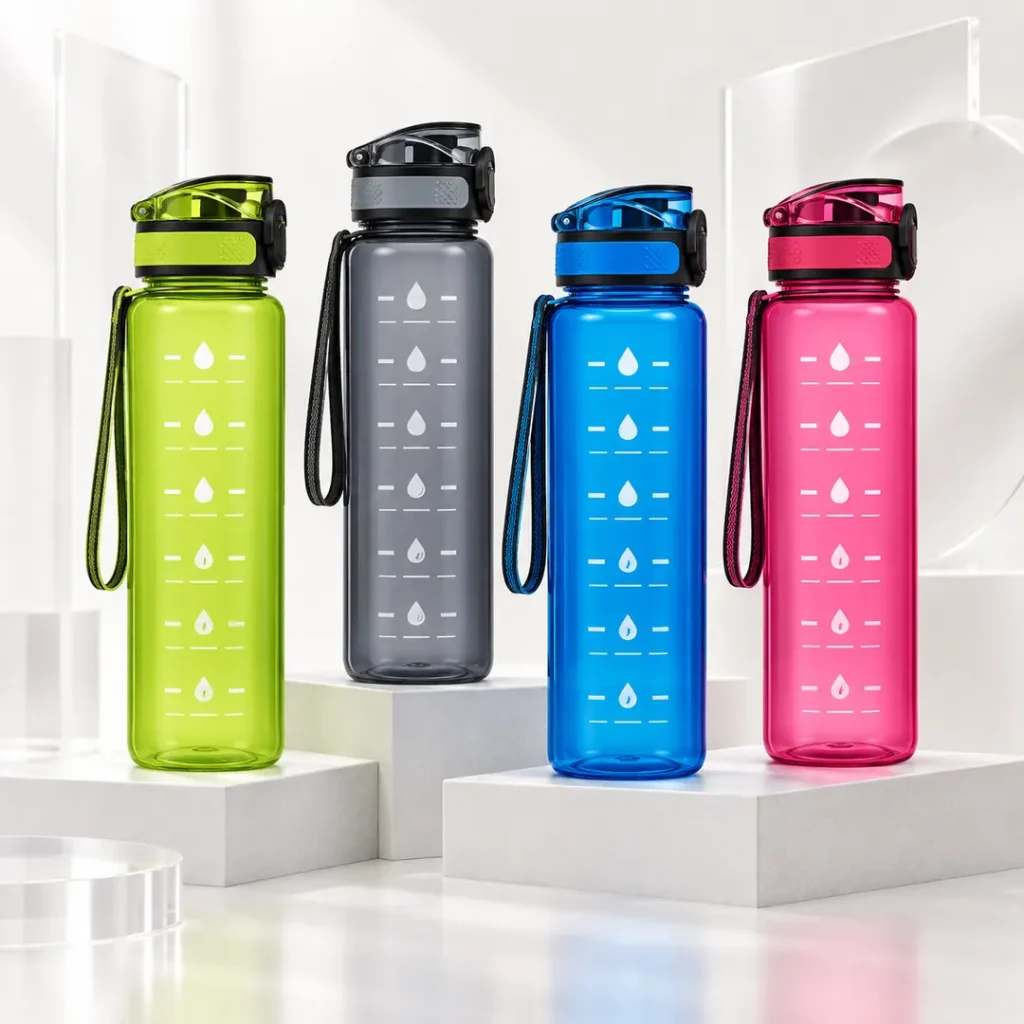
Water Bottle Lid Selection: Opening, Drinking and Cleaning
A water bottle lid is an assembly, not just a label such as "flip-top" or "straw." Opening method, drinking path, seal arrangement and cleaning access need to work together on the chosen bottle body. Specify the complete lid configuration and check its operation on an assembled sample before placing an OEM or wholesale order.
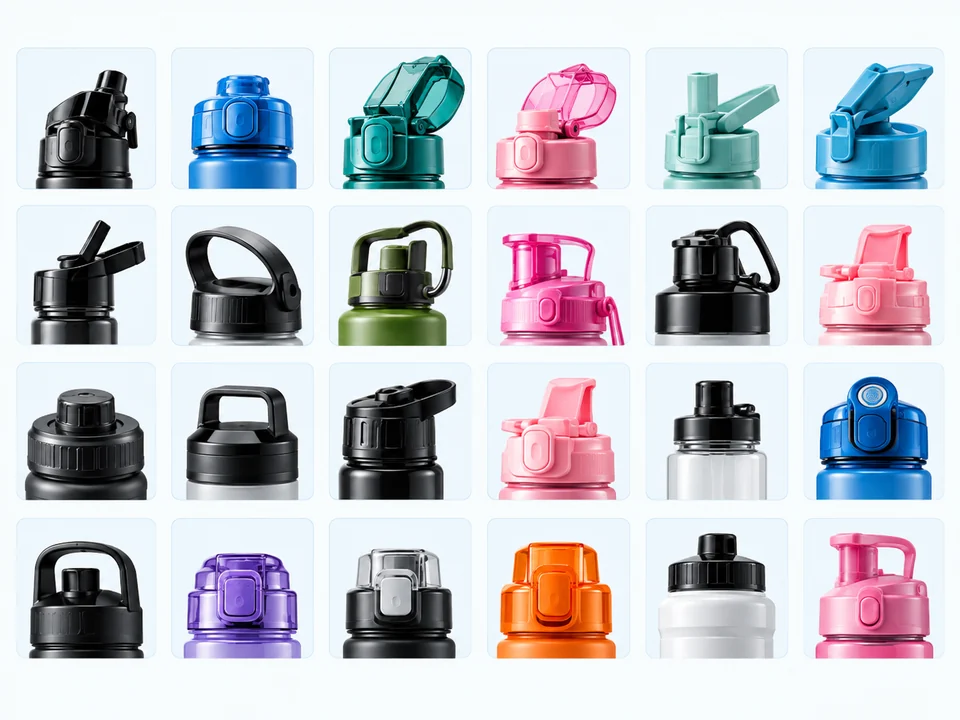
Separate opening method from drinking style
A push-button lid can also be a flip lid and use a straw. "Wide mouth" describes an opening or neck characteristic, not necessarily the way the user drinks while the lid is installed. An infuser is an accessory and does not, by itself, define the closure.
Use separate fields for the following features:
| Specification field | Examples to identify | What it answers |
|---|---|---|
| Opening mechanism | Screw closure, flip cover, push button, locking slide | How is the drinking opening exposed? |
| Drinking path | Direct spout, straw, squeeze nozzle | How does liquid reach the user? |
| Neck and filling access | Body opening dimensions and removable lid assembly | How are filling and internal cleaning performed? |
| Seal and vent arrangement | Body gasket, spout seal, straw port, vent | Which interfaces must close or function correctly? |
| Accessories | Infuser, mixing insert, carry loop, storage section | What additional parts are supplied? |
This avoids creating separate specifications for the same lid simply because a listing calls it "one-click," "push-button" or "flip-top." Confirm whether those terms describe the same component or different versions.
Compare complete lid combinations
| Combination | Potential benefit | Review before approval |
|---|---|---|
| Screw closure with direct drinking | Simple closure sequence and exposed drinking opening | Opening effort, seal seating and storage behavior |
| Flip cover with direct spout | Quick access without removing the full lid | Cover retention, spout seal and contact with the user's face |
| Push-button cover with a lock | Opening control with an additional closing step | Button force, lock engagement and accidental operation |
| Covered straw lid | Drinking without tipping the body as far | Straw assembly, port closure, vent and cleaning access |
| Squeeze nozzle | Flow controlled partly by squeezing the bottle | Body flexibility, nozzle behavior and compatible contents |
| Shaker closure with mixing insert | Closure combined with a mixing function | Insert fit, headroom, residue access and all closing interfaces |
Ask which opening and drinking systems are available for the chosen bottle body. Specify carry straps, powder compartments and fruit infusers separately because they add components without necessarily changing the drinking path.
For the appropriate bottle body, consult the material selection guide. For usable fill space and mixing headroom, consult the capacity selection guide.
Specify the parts that must stay compatible
Identify the bottle neck, lid shell, closure mechanism, gasket, drinking part, vent and accessories. Request a component drawing, assembly reference or labeled sample photographs where available.
Two lids that look alike may differ in neck threads, sealing depth, straw connection or hinge geometry. Do not approve interchangeability by appearance. A replacement lid must be verified against the actual body reference and the agreed functional checks.
For a straw model, record straw length, connection arrangement and removal method. For an infuser model, record how the insert attaches and whether it obstructs filling or cleaning. For a storage-section shaker, identify every detachable section and seal rather than treating the assembly as one closure.
Ask which replacement parts can actually be supplied, their references and any minimum purchase conditions. Replaceability is a commercial and compatibility question, not a benefit that should be assumed from a removable part.
Define a meaningful leak-check protocol
"Leakproof" is incomplete without test conditions. Agree the intended contents, fill level, lid assembly, closing method, orientation, exposure duration and environmental conditions. Include any insert or straw that forms part of the ordered model.
| Check | Conditions to record | Observation to capture |
|---|---|---|
| Upright storage | Fill level, contents, closing procedure and duration | Liquid at the neck, spout, vent or joint |
| Side or inverted storage | Agreed orientation and duration appropriate to intended use | Location and nature of any leakage |
| Transport handling | Actual packing or carry arrangement and agreed movement | Closure release, dripping or displaced parts |
| Open-and-close review | Defined operation sequence and repeat count | Lock engagement, cover retention and wear observations |
| Post-cleaning review | Agreed washing method and correct reassembly | Seal condition and closure function after cleaning |
Use only conditions appropriate to the specified product. Do not expose a cold-water bottle to hot liquids or pressure simply to create a more demanding test. Carbonated drinks, hot filling and unusual contents require separate suitability confirmation.
A threaded closure may need an agreed tightening method or torque; a button closure may instead require confirmation that the latch and lock are fully engaged. One closing instruction cannot cover every mechanism.
Review opening effort and drinking behavior
Operate the sample with the bottle filled to the intended level. Check how the lid opens while the bottle is being held, whether the cover interferes with drinking and whether liquid flows as expected through the selected path.
Record observations rather than assigning unsupported performance labels. "One-handed" should be evaluated with the actual mechanism and intended grip; a button's presence alone does not establish it. For a cycling bottle, body and nozzle behavior must be reviewed together, as explained in the cycling application page.
For school and kids bottle orders, confirm the intended age range, handling needs and component evaluation with the supplier and appropriate qualified reviewers. Review the lid together with the bottle body and supplied accessories; a "kids lid" name alone does not establish suitability.
Assess cleaning access before choosing a straw or insert
List the surfaces that contact the drink and the parts the user must remove. Examine the spout underside, straw port, vent, gasket groove and mixing or infuser attachment points.
Check whether parts can be removed without damage and reinstalled unambiguously. If a small seal has a specific orientation, request an assembly illustration or care instruction. Record whether a brush or other cleaning accessory is included or merely recommended.
Dishwasher instructions should cover the complete supplied configuration and state any required disassembly or placement restrictions. A dishwasher-suitable body does not prove that its lid, seal, straw or printed decoration has the same care limits.
Do not make easy-cleaning claims solely because the bottle has a wide neck. A large opening can improve body access while a complex lid still requires careful separate cleaning.
Use a sample review record that identifies the mechanism
- Record the body and lid component references.
- Name the opening mechanism and drinking path separately.
- Photograph the assembled, open and disassembled configurations.
- Record seals, vents, inserts and accessories supplied with the model.
- Agree the closing procedure and intended-use conditions.
- Complete the defined opening, drinking, leak and cleaning checks.
- Resolve observations and approve the final component set.
- Retain the reference sample and instructions for production and reorders.
The sample approval guide explains how to record approved, conditional and rejected items. A change to a gasket, straw, hinge or vent should be assessed for its effect on the approved assembly, even if the lid's outside color and shape remain the same.
Information to include in a lid quotation request
Provide the intended bottle model, opening preference, drinking path, locking requirement, supplied accessories, color references, cleaning expectations and replacement-part needs. Attach photographs or drawings of the required configuration without assuming that a competitor's part is interchangeable.
Ask the supplier to distinguish existing compatible components from development work. If a lid option is available only for one body size, record that limitation in the quote rather than carrying it across an entire bottle range.
Lid selection questions
Can a push-button lid also be a straw lid?
Yes. The button describes the opening mechanism, while the straw describes the drinking path. Record both features and the locking arrangement, if supplied.
Does wide mouth mean direct drinking?
Not necessarily. A wide body opening can support filling and cleaning, while an installed lid may use a straw or a smaller spout. Confirm both the neck opening and the drinking configuration.
Will a lid from a similar-looking bottle fit?
Appearance is not enough. Confirm the body and lid references, neck geometry, threads, sealing interfaces and functional checks before approving a replacement or shared component.
What information makes a leak check reproducible?
Record contents, fill level, installed parts, closing procedure, orientation, duration and environmental conditions. Also identify the sample and note where any leakage occurs.
Does a removable infuser make the lid easier to clean?
It can improve access to that accessory, but the spout, vent and seal grooves still need review. Check removal, cleaning and correct reassembly for the whole supplied component set.
Should a changed gasket require another approval?
Assess any change that can affect sealing or assembly. Confirm compatibility and repeat the relevant agreed checks before releasing the changed component to production.
Select the lid as a complete opening, drinking, sealing and cleaning system. A clear component record and a defined sample review are more useful than accumulating different marketing names for the same mechanism.