Water Bottle Capacity Selection: Volume, Filled Weight and Packing
Water bottle capacity affects carried weight, body dimensions, mixing space and packed volume as well as the amount of liquid held. Compare metric and fluid-ounce labels, confirm the rated and usable volumes, and check the assembled dimensions before approving a size for your product range or shipment.
Start with a precise capacity statement
Write the nominal capacity in one primary unit and identify the unit used for any conversion. A fluid ounce measures volume; an ounce can also refer to mass. US and Imperial fluid ounces are different, so an unqualified "oz" description can create ambiguity in artwork and quotations.
NIST lists one US fluid ounce as approximately 29.57353 mL and one Imperial fluid ounce as approximately 28.41306 mL. The rounded examples below use US fluid ounces. NIST volume conversion factors.
| US volume label | Approximate metric equivalent | Purchasing implication |
|---|---|---|
| 16 US fl oz | 473.2 mL | Not exactly the same as a 500 mL bottle |
| 20 US fl oz | 591.5 mL | Often compared with a 600 mL class, but confirm the actual rating |
| 24 US fl oz | 709.8 mL | Close to a 700 or 710 mL class, not an exact synonym |
| 32 US fl oz | 946.4 mL | Not exactly 1 L |
| 64 US fl oz | 1,892.7 mL | A US half gallon, not exactly 2 L or 2.2 L |
| 128 US fl oz | 3,785.4 mL | A US gallon; confirm the supplier's stated rated volume |
Check converted labels against the model's measured and declared volume. If a listing combines "1 L / 32 oz," agree the primary rated capacity and approved secondary label before printing. A US half gallon is approximately 1.893 L, so it is not an exact label for a 2.2 L bottle.
Separate rated, usable and brimful volume
Ask how the stated capacity is determined. Suppliers may use nominal design capacity, a marked fill line or a brimful measurement. These are not interchangeable.
- Rated capacity: the volume declared for the model under an agreed definition.
- Usable fill volume: the practical fill level with the selected lid and components installed.
- Brimful volume: liquid volume when the open body is filled to the top under a defined measurement method.
- Mixing volume: the fill amount that leaves the intended headroom for powder and shaking.
A straw, infuser or mixing insert can affect usable space. A shaker sold as a 700 mL model may have a lower recommended mixing fill line; do not infer the recommended powder recipe from the bottle's nominal size.
For approval, record the measurement method, fill reference, installed parts and agreed tolerance. Check whether scale markings are approximate user references or intended as measurement claims. The latter need separate verification appropriate to the claim.
Choose a size band around a physical requirement
Capacity bands are useful for shortlisting, but the sample must decide fit and usability. The examples below describe purchase trade-offs rather than prescribed daily water intake.
| Size band to compare | Potential purchase advantage | Main compromise to review |
|---|---|---|
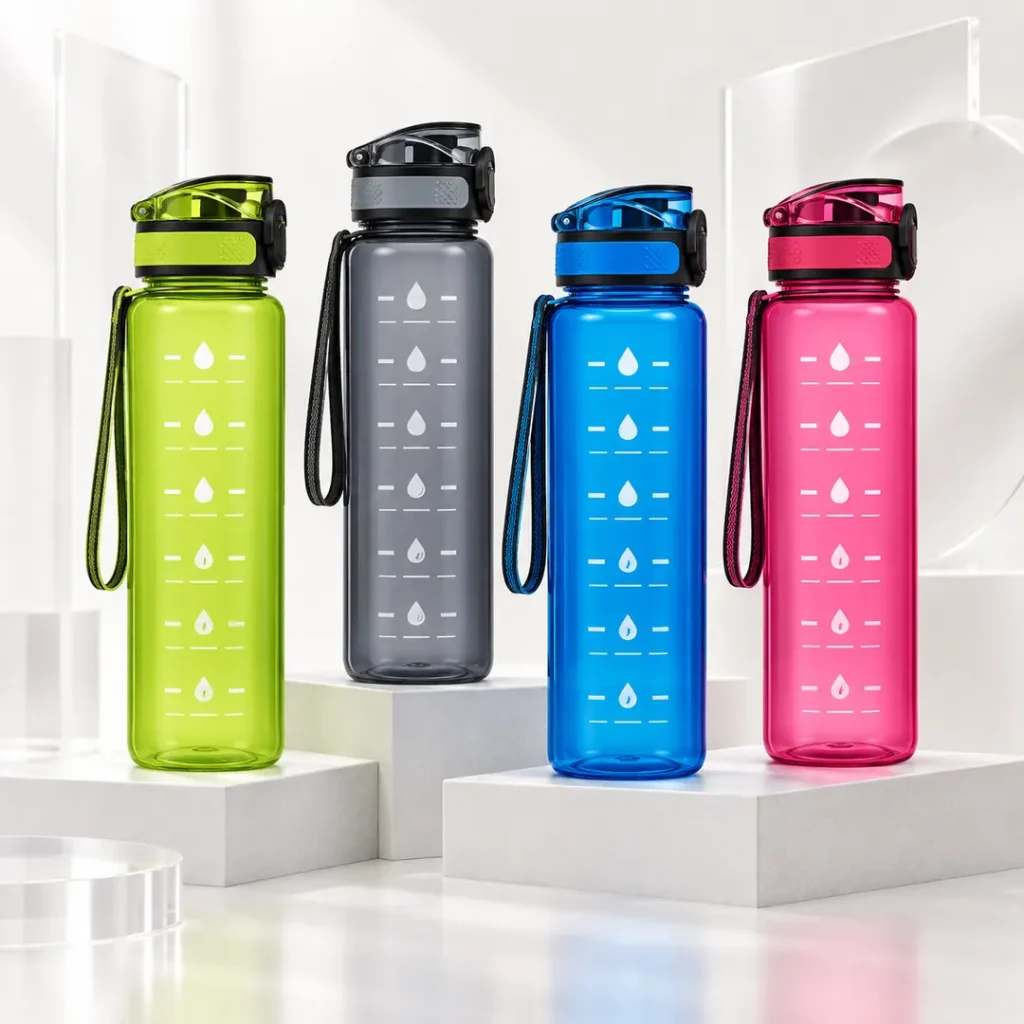
| Around 500-600 mL | Smaller packed unit and lighter carried load | More frequent refilling for some uses |
| Around 650-800 mL | Middle-size option for bottles and shakers | Body diameter and lid height can still vary considerably |
| Around 1 L | More liquid in a single container | Added filled weight and a potentially taller or wider body |
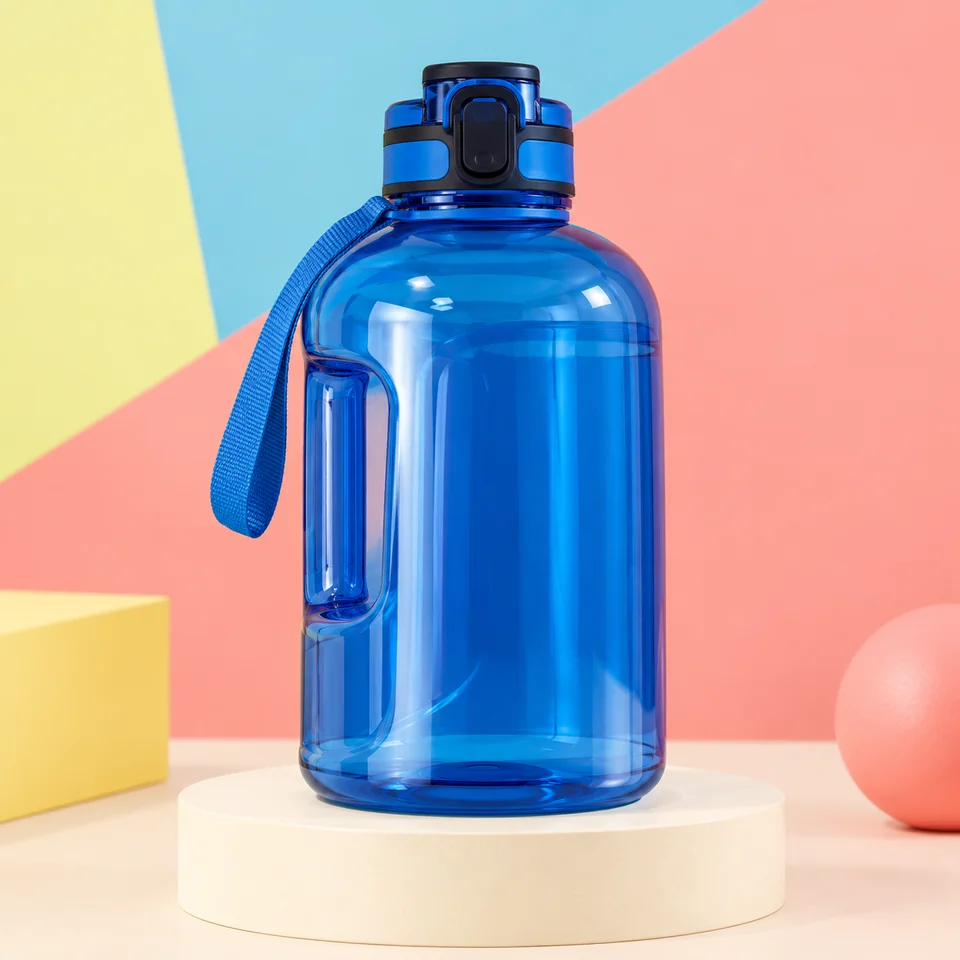
| Around 1.9-2.2 L | Large-volume jug option | Carry-handle comfort, storage footprint and carton size |
| Around 3.8 L | Very large-volume format | Heavy filled load and different handling and packing needs |
Not every listed size band is available in every model, material or lid system. Ask for the exact model options instead of requesting a capacity change as if the existing mold can simply be resized.
For cycling bottles, confirm fit against the cage and frame dimensions. For travel and commuting bottles, check bag compartments and the intended vehicle holder. In both cases, use the assembled bottle dimensions rather than nominal capacity alone.
Calculate filled weight before approving a large bottle
For rough planning, a liter of water contributes approximately a kilogram near ordinary room conditions. This is an estimate for handling comparisons, not a precision measurement rule. Add the measured empty weight of the complete bottle, including its lid and supplied accessories.
Calculation example: an empty assembly weighing 180 g and filled with 750 mL of water has an estimated carried load of 930 g. Use the measured empty weight and intended fill volume of your selected sample when comparing models.
Repeat the check on the actual assembled sample. A different lid, carry handle or accessory set can change empty weight. Large jugs also need a filled handling review: handle clearance, strap arrangement and closure access may matter more than the empty body's appearance.
Verify dimensions independently of volume
Two 750 mL bottles can have different footprints. One may be tall and narrow, another short and wide. A lid with a projecting carry loop can change overall height even when the body is unchanged.
| Measurement | Use it to confirm |
|---|---|
| Maximum outside diameter or width | Holder, cage, shelf or bag clearance |
| Overall assembled height | Shelf height and package internal space |
| Base footprint | Standing space and stability review |
| Neck opening | Filling and access for cleaning |
| Handle or loop envelope | Clearance around carry and storage arrangements |
| Packaged dimensions | Selling-unit space and carton planning |
Record measurements with the selected lid installed. Claims such as "fits most cup holders" should not replace an actual holder specification or fit check. If the bottle must fit a particular dispenser, cage or equipment tray, provide that interface or its dimensions during sourcing.
Plan a capacity range without creating accidental variants
When a product family offers more than one size, identify each size as its own production specification. Confirm whether lids, seals, straws and packaging are shared or size-specific. Similar appearance does not establish interchangeability.
Consider whether the extra size meets a distinct purchase need. Adding three almost-identical volumes can increase artwork, cartons and stock complexity without providing a meaningful range. Conversely, a compact model and a large jug may justify separate packaging and handling instructions because their physical requirements differ.
The MOQ planning guide explains why total order quantity may need to be split by model, size, color and packaging version.
Include capacity in packaging and shipment approval
Do not calculate carton size from liquid volume. Use measured packaged dimensions and the approved arrangement of the actual units. Body shape, lid projections, inserts and protective packaging determine the packed space.
Ask for selling-unit dimensions, units per carton, carton external dimensions and gross weight. Verify the shipping configuration using the same assembly that was sampled. If a larger capacity uses the same retail box name, check whether the box dimensions or insert have actually changed.
Use the packaging guide to record the selling-unit and carton specification separately from bottle capacity.
Capacity approval checklist
- Select the exact model and size option.
- Agree the primary rated volume and definition.
- Verify any US or Imperial fluid-ounce conversion used on artwork.
- Record usable fill space with the chosen components installed.
- Check scale markings and mixing headroom where applicable.
- Measure assembled dimensions and empty weight.
- Review the filled assembly and required physical interfaces.
- Approve packaging and carton data for that size.
Keep these observations with the sample approval record. If the lid, body or insert changes, review the capacity-related measurements affected by that change.
Capacity selection questions
Is a 1 L water bottle exactly 32 US fl oz?
No. Thirty-two US fluid ounces is approximately 946.4 mL. Confirm which rated volume the model uses and whether the secondary label is an approximate description or a verified declaration.
Does a 2.2 L bottle equal a US half gallon?
No. A US half gallon is approximately 1.893 L. A 2.2 L model may belong to a large-jug product class, but it should not use an exact half-gallon conversion claim without clarification.
Why does a shaker's mixing line sit below its stated capacity?
Mixing can require space for powder, the insert and movement of the contents. Ask for the intended fill line and usable mixing volume rather than assuming that a brimful bottle can be shaken effectively.
Can capacity tell me whether a bottle fits a cup holder?
No. Maximum diameter, base shape and the holder's geometry determine fit. Check an assembled sample against the specific holder or supplied interface dimensions.
How should I compare the weight of two different capacities?
Weigh both complete empty assemblies and add the intended contents for a rough planning comparison. Then review the actual filled samples, including their handles and closures.
Can two sizes use the same lid and packaging?
Sometimes, but only if the components and packaging are specified for both models. Confirm neck compatibility, straw length, sealing parts, internal clearance and the carton arrangement before sharing references.
Approve capacity as a set of volume, dimensions, filled load and packaging data. This avoids labeling ambiguity and makes the purchased size easier to reproduce on future orders.