Water Bottle Packaging: Selling Units, Protection and Carton Planning
Water bottle packaging must present the correct selling unit and protect it through storage, handling and delivery. A box that looks good on a desk can still let the lid rub against an insert, hide the barcode or consume too much shipping space. Approve the bottle, accessories, individual pack and export carton together so the delivered product is ready for its sales channel.
Start with the destination channel and the complete packed product. Confirm whether the customer receives one assembled bottle, a bottle with loose spare parts, a gift kit or a multipack. Those differences affect internal space, labeling, assembly work and carton counts before artwork is designed.
Define What One Selling Unit Contains
A purchase order should make the contents of one saleable unit unambiguous. List the body, lid, seal, straw, mixing insert, carry part and any instruction or accessory included. State whether parts arrive assembled or separately protected. Identify the model and variant so a packing team does not substitute visually similar components.
Decide where the unit is opened for the first time. A bulk giveaway may need a simple individual protector; a retail package may need visible product information; a gift kit may need a stable arrangement of several items. Confirm the receiving channel's labeling and preparation requirements rather than assuming all warehouses use the same rules.
| Packaging format | Direction to consider | Approval questions |
|---|---|---|
| Individual protective bag | Bulk distribution or a protected inner unit | Closure, scuff protection, labeling and destination restrictions |
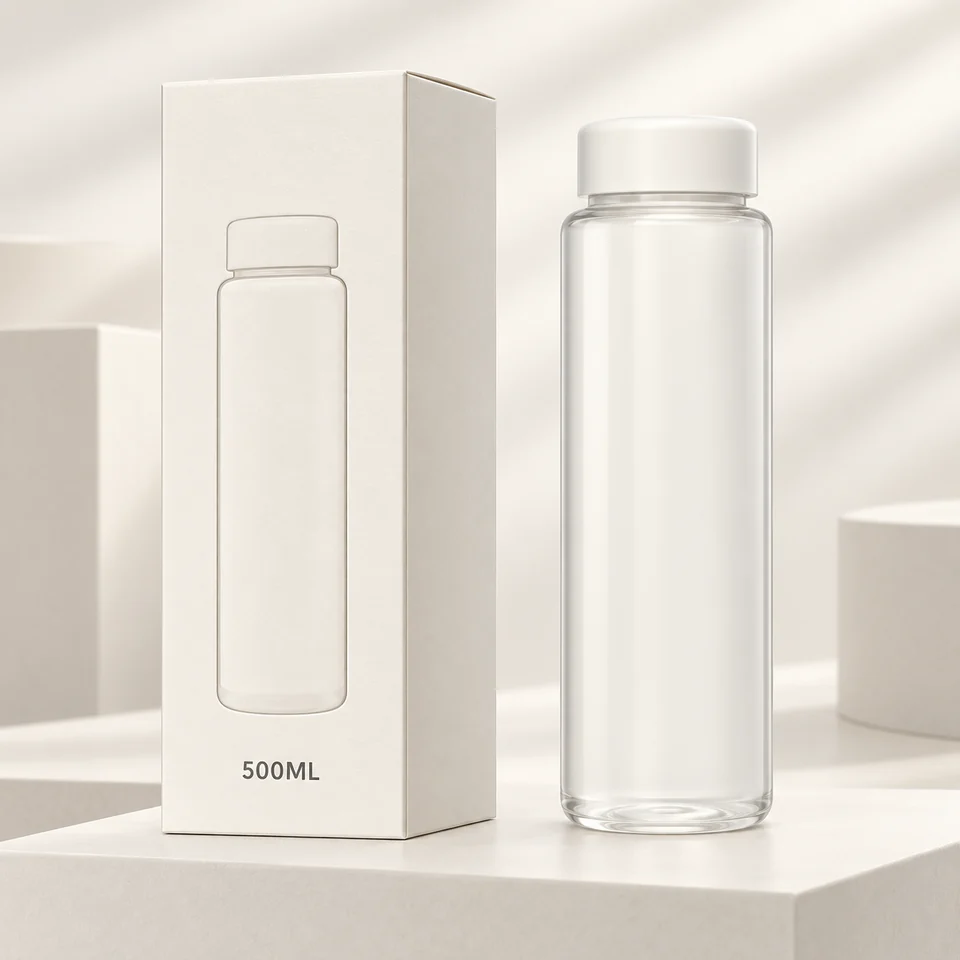
| Plain or white box | Simple independent packing | Internal restraint, model identification and correct dimensions |
| Printed retail box | A consumer selling unit | Artwork, barcode access, product identity and shelf orientation |
| Gift box or sleeve | A coordinated kit or presentation | Retention, accessory separation, closure and extra packing steps |
| Display or multipack unit | Several bottles sold or presented together | Variant mix, unit identity, total size and replenishment handling |
| Master shipping carton | Transport and warehouse handling | Counts, partitioning, strength, marks and distribution hazards |
These formats are not fixed protection grades. A gift box is not automatically stronger than a plain box, and a bag is not suitable for every delivery channel. Inspect the complete design with its real contents.
Use Packed Dimensions, Not Bottle Capacity, to Size the Package
Measure the bottle at the highest and widest points with the final lid, handle and carry parts fitted. Record projections that can catch on an insert or press into another item. Nominal capacity cannot determine box dimensions: two 700 ml bodies can have different heights and shoulders.
Build the packaging around an approved arrangement. Provide enough clearance for insertion and removal without allowing uncontrolled movement. Where an insert holds the body, make sure it does not force a lid open, distort a flexible bottle or scrape the decorated panel. Loose accessories need their own position so they do not become abrasion sources.
| Dimension record | Why it matters |
|---|---|
| Complete bottle height and widest profile | Establishes the space the unit actually needs |
| Inner pack dimensions | Shows usable clearance and restraint |
| Outer selling-unit dimensions | Supports shelf, fixture and logistics planning |
| Master carton external dimensions | Supports handling and freight quotations |
| Units per carton and carton gross weight | Supports warehouse receiving and packing verification |
Request a dimensioned drawing and a plain physical prototype before committing to printed cartons. Do not calculate a final shipping quote from an early bottle rendering or an assumed units-per-carton figure.
Keep Product Artwork and Packaging Artwork Separate but Consistent
The bottle logo and the package have different file and layout requirements. Obtain the packaging supplier's approved dieline, identify cut and fold lines, and keep technical lines separate from printable artwork. Define bleed, safety zones and finishes using that template rather than a universal margin.
Check product photographs against the final sample. A box must not show a straw lid when the enclosed variant is direct-drink, or a shade that was replaced during approval. Use the agreed model name, volume, variant and care information consistently across the package and product listing.
- Assign one artwork revision to each selling-unit layout.
- Mark front, back, top and bottom orientation on the proof.
- Verify spelling, intended language and the contents list.
- Keep unsupported performance or certification statements off the pack.
- Review finishes and windows with the actual packaging producer.
Barcode data and printing are separate checks. Confirm the code assigned to the saleable SKU, then check the final printed label in its actual location with the receiving system or an appropriate verifier. A barcode visible in the PDF can become hard to scan over a fold or curved bottle surface. Retail and marketplace requirements must be checked for the actual destination, not inferred from a generic example.
Prevent Damage Between the Bottle and Its Own Packaging
Identify contact points after the pack is closed. Lid edges, carry rings and loose mixing parts can mark the body even when the outer carton stays intact. Protect approved decoration without using an insert or adhesive that transfers marks or leaves unwanted residue.
Consider how the pack is stored and handled: compression, motion, handling drops and environmental exposure may require different design responses. Evaluate a production-representative pack rather than a carefully assembled one-off prototype that cannot be reproduced on the packing line.
If distribution testing is needed, select the protocol for the complete packaged product and intended delivery route. ISTA's guidance emphasizes the distribution environment and the decision the test should support; one generic drop height does not validate every transport arrangement. ISTA test-selection guidance
Document the tested contents, insert, carton, closure and revision. A changed carton size, material or accessory arrangement may require reassessment. Do not describe a pack as ISTA certified just because a supplier performed an informal drop check.
Plan Master Cartons and Case Identity
Agree whether a case contains one SKU or an approved mix. Mixed cases require a contents record that the warehouse can distinguish from an individual selling-unit barcode. Record carton numbering, variant quantities, destination marks and any receiving labels requested by the buyer.
Use the supplier's actual packing arrangement to confirm count and weight. For the same bottle, a changed lid, retail box or kit accessory may alter the number of units per carton. A rounded order quantity also needs a plan for any partial case.
Packing instruction example: Model03 / white lid / Pack R03 / 24 individual units / single-SKU case. Replace the model, color, revision and case count with your approved order details, then add measured carton dimensions, gross weight and the final case-label file.
Approve the Packing Operation, Not Only the Box
Ask for a complete packed sample and, where appropriate, a representative master carton. Check that ordinary packing staff can reproduce the arrangement without bending components or guessing which label belongs to the unit.
- Confirm the contents and assembly state of one selling unit.
- Review the blank prototype, dimensions and internal contact points.
- Approve the print proof, product information and variant label data.
- Assess the finished pack and required distribution checks.
- Record the packing sequence, case count and outer marks.
- Inspect packing-line output and final shipment identity.
Use the sample approval guide to document the release decision. Minimum printed-box quantities and the effect of several artwork variants belong in the MOQ planning guide.
Packaging Acceptance Checks
| Area | What to compare with approval |
|---|---|
| Contents | Correct bottle, lid, seal, accessories and instructions |
| Retention | No uncontrolled movement or pressure on working parts |
| Appearance | Correct print, finish, closure and undamaged decoration |
| Identity | Model, capacity, variant, barcode and revision match |
| Case packing | Approved count, orientation and variant composition |
| Shipping record | Actual carton dimensions, weights and required labels |
Packaging checks do not replace functional bottle inspection. A neatly packed wrong lid remains a product error, while a correct bottle in the wrong variant box is a packing error. Keep both visible in the inspection record.
Packaging Questions
Can I select a retail box from the bottle's volume alone?
No. Measure the complete bottle and accessories, then confirm internal restraint and outer dimensions. Capacity is a product specification, not a box-size formula.
Is one barcode enough for a mixed-color retail range?
Follow the buyer's saleable-SKU assignments and receiving system. Verify each finished variant label against that system; do not assume one shared code meets every channel's requirements.
Should spare lids or mixing inserts be packed loose?
Only if the arrangement is approved and protects both the parts and the bottle. Include their location and retention in the packing instruction, especially where they could rub against print.
Does a decorative gift box replace a shipping carton?
Not automatically. Evaluate the complete shipping configuration and delivery route. A presentation box may need a separate protective outer carton or other approved protection.
What changes require another packaging review?
Review changes to contents, bottle profile, insert, box dimensions, carton material, case count, closure and delivery channel. Artwork changes also need identity and label checks even if the structure stays the same.
Who should approve warehouse labels and case marks?
The buyer should identify the receiving requirements, and the supplier should confirm they can be applied in production. Approve the final files and their placement before packing starts.
For shelf assortment and store allocation, use the retail bottle program scenario. For a packaging quotation, send the complete contents list, measured bottle profile, desired selling unit, artwork versions, case requirements and receiving destination together.