
Tritan vs PP Water Bottles: Materials, Components and Specification Checks
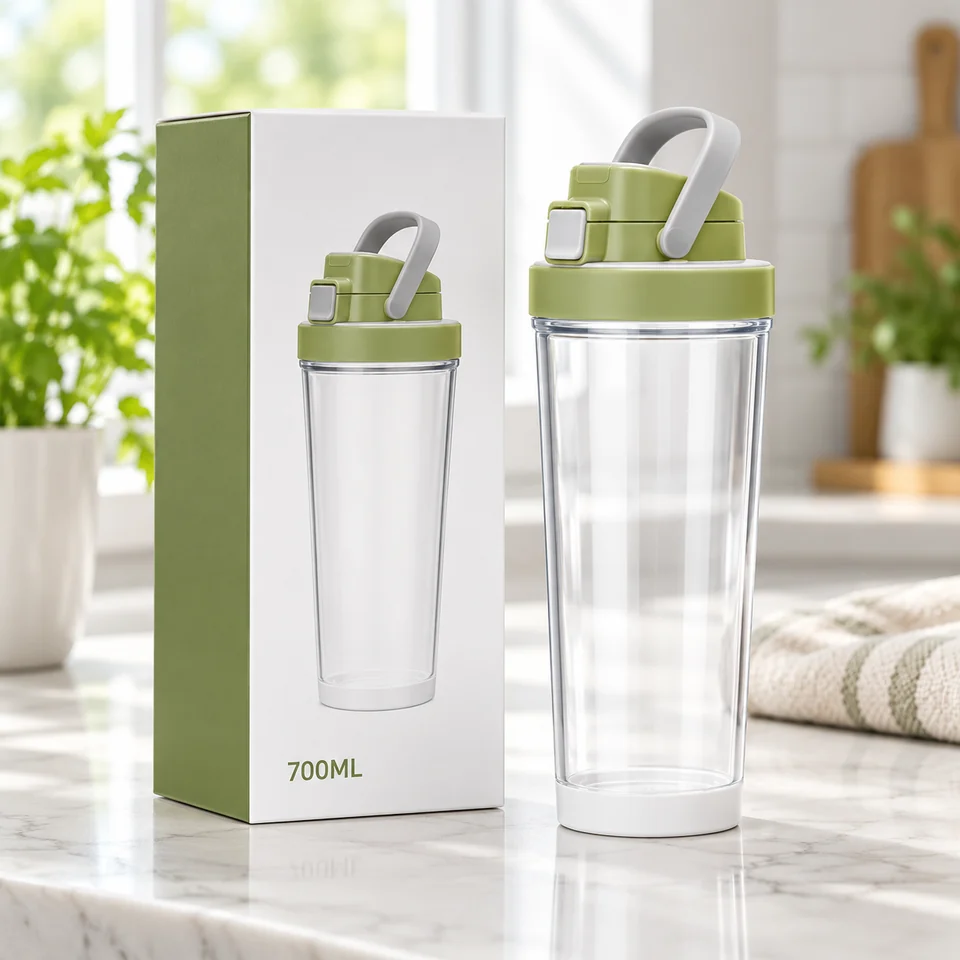
Choosing between Tritan and PP water bottles starts with the actual resin grade and finished bottle specification, not a material name on a quotation. Compare clarity, construction, decoration and care requirements before approving a model. Record the bottle body, lid, seal and accessories separately, including mixed-material assemblies such as a Tritan body with a PP lid.
Identify the material before comparing prices
Tritan is Eastman's brand of copolyester. PP means polypropylene, a polymer family with different grades and formulations. Neither name alone tells you the finished bottle's operating temperature, dishwasher suitability, impact performance or destination-market documentation.
Request the resin grade specified for your order and its current material information. Manufacturer data is grade-specific: for example, Eastman publishes properties and applications for EX501 copolyester. Check the data for the grade actually quoted for your bottle. Eastman EX501 product information.
Descriptions such as "plastic," "flexible plastic" and "frosted plastic" are not a complete resin specification. Frosting can describe a finish; flexibility can describe behavior. If a listing offers "plastic / Tritan options," request separate specifications and prices for each option rather than treating them as interchangeable.
Compare Tritan and PP by purchase requirement
| Purchase requirement | Tritan bottle review | PP bottle review | Evidence to request |
|---|---|---|---|
| Contents visible through the body | Check actual clarity, tint and molded markings | Check the offered grade and finish; PP is not always opaque | A production-representative sample in the quoted color |
| Carry weight | Weigh the complete model with its lid and accessories | Do the same for the proposed PP model | Empty assembly weight and component list |
| Repeated handling | Review the actual body design and intended handling conditions | Review wall design, hinge components and intended handling conditions | Agreed handling checks on the finished assembly |
| Printed branding | Check pretreatment, ink or transfer compatibility | Confirm surface preparation and adhesion for the selected grade | Decorated sample plus the agreed durability checks |
| Washing | Confirm the complete assembly's care instructions | Confirm body, lid and accessories separately | Written washing limits and supporting evaluation |
| Price | Compare the specified model, color, print and packaging | Compare an equivalent specification, not a different construction | Itemized quotation with identical inclusions |
Some PP grades can offer high clarity. For example, LyondellBasell describes Moplen RP348N as a high-clarity random copolymer. Its properties should not be generalized to every PP water bottle. LyondellBasell Moplen RP348N.
The useful comparison is therefore not "clear Tritan versus opaque PP" or "premium versus cheap." It is whether each quoted construction meets the same visible, functional and commercial requirements.
Build a component-level material record
A bottle can contain several materials. A description such as "Tritan body / PP lid" identifies two parts, but may leave the seal, straw, carry loop and decoration unspecified.
| Component | Record before approval | Why it matters |
|---|---|---|
| Bottle body | Resin identity, grade where available, color and finish | Determines the body specification and decoration surface |
| Lid shell and opening mechanism | Material, hinge construction and locking parts | Influences opening behavior and serviceability |
| Seal | Material, position and replacement reference | Affects closure assembly and cleaning access |
| Straw or spout | Material and removable-part arrangement | Defines the drinking path and cleaning work |
| Mixing or infuser insert | Material, fit and removal method | Adds food-contact surfaces and assembly steps |
| Decoration | Ink, transfer, coating or marking process | Introduces a separate durability requirement |
Keep this record with the model reference, artwork revision and sample approval. A body material change is not the only change that can affect the finished product: a substituted seal, colorant or printed coating may also require review.
The water bottle lid selection guide explains how these components work together during opening, drinking and cleaning.
Check intended use and documentation together
Define the intended drink types, filling conditions, storage conditions and cleaning method before asking for supporting documents. A bottle intended for cold water is not automatically suitable for hot filling, carbonated drinks or extended chemical exposure.
Ask the supplier to identify which documents apply to the resin, which apply to individual components and which apply to the finished decorated model. Match model references, colors, dates and tested configurations. A resin information sheet does not by itself establish every claim for the assembled bottle.
If a quotation uses claims such as "BPA-free," "dishwasher-safe" or "food-contact compliant," request the applicable basis and intended-use limits. Do not turn one claim into a blanket statement about all chemicals, all washing programs or every sales market. Destination-market requirements should be reviewed by a qualified party for the actual product and use.
Questions that expose an incomplete material specification
- Is the quoted resin fixed, or can it be substituted during production?
- Are all colors made with the same specified body grade?
- Does the supporting evaluation cover the selected lid, straw and decoration?
- Are washing instructions based on the finished assembly or only the body?
- What changes would trigger new documentation or a new approval sample?
- Which component reference will be supplied when replacement lids or seals are ordered?
Review transparency, finish and branding on real samples
Evaluate clear and tinted bottles with the intended markings and contents. A light-colored logo can disappear against an empty transparent bottle yet become visible with a dark drink inside. Frosted finishes may change contrast and the appearance of a scale.
For printed bottles, review the exact surface used for production. Record whether a coating or surface treatment is part of the specification, and compare decoration after the agreed wash and handling checks. Changing from one resin or finish to another may require a different decoration setup.
Laser marking also needs a sample on the actual material. Do not assume a process that works on stainless steel produces the same result on Tritan or PP. Contrast, appearance and process suitability depend on the substrate and equipment. Use the logo printing guide to define the artwork and inspection record.
Compare models without confusing material with design
A PP shaker with a wide mixing chamber and a slim Tritan drinking bottle solve different design requirements. Their weight, seal arrangement and packing volume cannot be attributed to resin alone.
Where possible, compare models with similar volume, lid functions, accessories and packaging. Where that is not possible, list the differences explicitly. For example, "PP shaker with mixing insert" and "Tritan direct-drink bottle without insert" are different assemblies, not a controlled material comparison.
For sports and fitness bottle orders, establish whether you need a drinking bottle, shaker or large jug, then compare material options on models with the required function and components.
Release the chosen material into the order specification
- Identify the exact model and all material options offered for it.
- Record the body, lid, seal and accessory materials separately.
- Agree the intended use and care limits.
- Review the relevant documents and their model references.
- Approve a representative sample in the ordered color and decoration.
- Record approved substitutions, or state that substitutions require written approval.
- Keep the material record with the purchase order and retained sample.
For a first order, use the sample approval guide to connect material evidence with the physical approval record. For a reorder, compare the component specification as well as the bottle's external appearance.
Material selection questions
Are all Tritan water bottles dishwasher-safe?
No universal claim should be made from the material name alone. Confirm the selected body, lid, seals, accessories and decoration, together with the specified washing conditions and care instructions.
Is PP always opaque?
No. PP grades and finishes differ, and high-clarity grades exist. Judge the actual offered bottle and its color rather than using opacity as a resin-identification test.
What does "Tritan body / PP lid" mean?
It describes a mixed-material assembly: the body and lid shell use different material families. It does not necessarily specify the seal, straw, hinge parts or decoration, which still need to be recorded.
Is frosted plastic a separate material?
Not necessarily. "Frosted" can describe a surface appearance or finish. Request the underlying resin specification and the method used to achieve the finish.
Can a logo printing process be transferred from PP to Tritan?
It should be reviewed again on the actual substrate and finish. Surface preparation, ink compatibility and appearance may differ, so approve a representative decorated sample before production.
What should I check when reordering the same material bottle?
Confirm the model, body grade or agreed material specification, color, lid and seal references, accessory set and decoration process. An unchanged shape does not prove that all components remain unchanged.
Choose the material on the strength of a complete specification and an approved assembly. That produces a more reliable purchasing decision than comparing resin names, generic safety claims or photographs alone.