
Tritan vs PP Water Bottles: Which Material Fits Your Project?
Key Takeaways
- Tritan™ copolyester is typically chosen for high-clarity premium bottles, while PP is chosen for lightweight, lower-cost translucent or opaque formats.
- A resin name alone does not prove food-contact status, performance or compliance; verified claims apply to the specific grade and finished product.
- Impact resistance, leak performance and cleaning durability are assembly-level results that depend on design, processing and test conditions.
- Buyers should confirm the exact resin grade, decoration compatibility, closure specification and destination-market documentation before production.
- Tritan™ is Eastman’s copolyester brand and includes multiple grades, so properties must be verified for the grade in use.
Tritan™ copolyester and polypropylene (PP) are both widely used for reusable plastic water bottles, but they solve different problems: Tritan is chosen when clarity and a premium look matter, while PP is chosen for a lightweight, low-cost, opaque or translucent bottle. The right choice depends on your target market, decoration plan, cleaning routine, and the documentation your buyer requires — not on a single material ranking.
Which material questions matter for this project
Before comparing resins, buyers should define the project in writing. Material selection follows from the answers, not the other way around.
- Bottle type and use case: a sports squeeze bottle, a straw bottle, a motivational bottle, a protein shaker, or a kids bottle each place different demands on the body, lid, and closure.
- Transparency expectation: does the product need to show the liquid clearly, or is an opaque or frosted look acceptable?
- Weight and wall thickness: lightweight retail bottles and heavier premium bottles use different design approaches.
- Decoration: printing, labeling, and finishing methods interact with the substrate, so confirm decoration capability for the exact material and part.
- Cleaning and refill behavior: hand wash, dishwasher, and repeated refill patterns affect how a bottle is specified.
- Documentation: food-contact declarations, migration testing, and market-specific paperwork are often the deciding factor.
These questions map directly to the plastic water bottle types a buyer’s guide for custom orders covers, and they should be settled before tooling or sampling discussions begin.
Plain-language comparison of Tritan, PP, PETG and PE

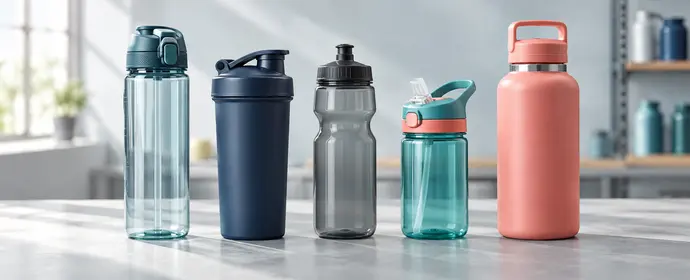
Tritan™ is Eastman’s brand of copolyester, and it is not a single formulation — different grades exist, so properties and documentation must be verified for the specific grade you intend to use. In general terms, Tritan is associated with high clarity, a glass-like appearance, and good toughness in finished parts. It is commonly specified for premium reusable bottles, including Tritan water bottles in sports, straw, and motivational formats.
PP (polypropylene) is a commodity polyolefin. It is typically lower in cost than copolyester, naturally translucent to opaque, lightweight, and widely used for caps, closures, and bottle bodies. PP is a common choice for promotional bottles, kids bottles, and value-tier retail programs where clarity is not the priority.
PETG is an amorphous copolyester with good clarity and ease of processing. It is often used where a clear, glossy look is wanted at a different cost position than Tritan. PETG is not the same as PET used for single-use beverage bottles, and buyers should not assume interchangeable performance or documentation.
PE (polyethylene) — HDPE and LDPE — is flexible, opaque, and low cost. It is more common in squeeze bottles, jugs, and utility containers than in premium clear drinkware. It is rarely the first choice when transparency is a requirement.
| Material | Typical positioning | Clarity tendency | Where buyers usually start |
|---|---|---|---|
| Tritan™ copolyester | Premium reusable bottles | High clarity | Sports, straw, motivational, retail private label |
| PP | Value and promotional | Translucent to opaque | Promotional events, kids, value retail |
| PETG | Clear, glossy mid-tier | High clarity | Display-driven retail, custom logo programs |
| PE | Utility and squeeze | Opaque | Squeeze bottles, jugs, non-clear applications |
This table is a starting point, not a specification. Resin names alone do not prove compliance, performance, or suitability for a given market.
Transparency, weight, impact resistance, flexibility, odor, cleaning and product-design considerations
These attributes drive most material decisions, and each one interacts with the others.
- Transparency: Tritan and PETG are typically selected when the bottle must show the liquid. PP and PE are used when an opaque or frosted appearance is acceptable or preferred.
- Weight: PP parts can often be designed lighter for the same volume, which matters for freight cost and retail shelf presence. Tritan bottles often carry a heavier, more premium feel.
- Impact resistance: finished-part performance depends on wall thickness, geometry, gate location, and drop conditions. Do not assume a resin name guarantees a drop-test result; request the applicable test document for the exact product.
- Flexibility: squeeze bottles need controlled flex and recovery. PP and PE are common in squeeze formats, while rigid copolyester bodies suit straw and wide-mouth designs.
- Odor and taste: residual monomers, additives, and processing conditions can affect sensory performance. This is a grade-and-process question, not a material-family question.
- Cleaning: dishwasher exposure, hot water, and repeated washing can affect appearance and dimensional stability. Confirm the cleaning instructions the supplier supports for the exact product.
- Product design: thread design, lid fit, gasket choice, and straw or spout geometry all influence perceived quality and leak behavior. Leak performance must be verified on the finished assembly, not inferred from the resin.
Decoration also belongs in this list. Printing, labeling, and finishing methods behave differently on copolyester and polyolefin surfaces, so decoration capability should be confirmed against the specific material and part.
Use limitations and why material behavior depends on grade, design, processing and test conditions
Material data sheets describe resin under defined conditions. A finished bottle is a different object: it has been melted, flowed, cooled, and assembled. That is why two bottles made from the same resin family can behave differently in the field.
Processing variables that matter include drying, melt temperature, mold temperature, cooling time, and gate design. For copolyester parts, drying and residual stress management are commonly discussed because they influence clarity and dimensional consistency. For PP, shrinkage behavior and warpage control are frequent topics. In both cases, the practical result is measured on the finished part.
Use limitations to keep in mind:
- No material is universally suitable for every fill, cleaning method, or climate.
- Temperature exposure limits are grade-specific and must be verified for the intended use.
- Chemical resistance varies by substance and concentration; a bottle suitable for water may not suit other contents.
- Recyclability claims depend on local infrastructure and the full package, not the resin name alone.
- Impact and leak performance are assembly-level results, not resin-level guarantees.
When a project involves unusual contents, aggressive cleaning, or extended outdoor use, the specification should be built around test conditions rather than assumptions.
Target-market questions: food-contact declarations, test reports and buyer-specified documentation
Documentation is often the real differentiator between two otherwise similar quotes. Buyers should ask for the documents their market actually requires, and they should ask for them by product, not by material family.
Typical document categories include:
- Food-contact declarations: statements that the finished article is suitable for food contact under specified conditions of use.
- Migration or extraction test reports: testing performed on the finished product or representative sample, per the applicable standard.
- Material safety data and grade information: resin grade identification and supplier documentation.
- Market-specific paperwork: declarations, labeling requirements, or registration documents for the destination country.
- Quality and process documentation: inspection records, batch traceability, and packing verification.
A resin name does not prove compliance. A Tritan™ label does not by itself establish food-contact status, and a PP label does not by itself establish suitability for a given fill or cleaning regime. The verified claim belongs to the specific grade and finished product, supported by the applicable document.
Buyers working on private label or retail programs should also confirm labeling content, language requirements, and any claims that will appear on pack. Claims about safety, performance, or environmental attributes should be supported by documentation before they are printed.
What the buyer must confirm for the exact material, product and destination market
Before committing to a material, confirm the following with the supplier in writing:
- The exact resin grade and its supplier documentation.
- The finished product’s food-contact status and the conditions of use it covers.
- Test reports applicable to the finished article or representative sample.
- Decoration method and its compatibility with the chosen material and part.
- Cleaning instructions the supplier supports, including dishwasher guidance if offered.
- Closure, gasket, and straw specifications, and how leak performance is verified.
- Packaging format, carton configuration, and labeling requirements.
- Destination-market documentation and any registration or declaration needs.
- Sample approval criteria and the specification sheet that will govern production.
Where a claim depends on the product, grade, market, or supplier, request the applicable specification, test document, sample, or quotation rather than relying on a general statement. This is standard practice for material comparisons and protects both the buyer and the supplier.
Where buyers should go next: compare product categories, documentation needs and inquiry options
With the material direction set, the next step is to match it to a product format and a documentation package. Buyers can compare plastic water bottles by category, review customization options such as custom logo water bottles and private label water bottles, and check application pages for sports and fitness, school and kids, promotional events, and retail and private label programs.
For teams that need to align material, decoration, and packaging in one review, the customization page and the manufacturing overview are useful starting points. When the specification is ready, submit an RFQ with the target market, intended use, decoration plan, and required documentation so the supplier can respond with an accurate quotation and sample plan.
Frequently Asked Questions
Is Tritan better than PP for water bottles?
Neither material is universally better. Tritan™ copolyester is usually selected when clarity and a premium appearance are priorities, while PP is selected for lightweight, lower-cost bottles where transparency is not required. The right choice depends on the use case, decoration plan, cleaning routine and documentation needs.
Does a Tritan water bottle automatically meet food-contact requirements?
No. Food-contact status applies to the specific grade and finished product, supported by the applicable declaration or test document. A resin brand name does not by itself establish compliance for a given market or condition of use.
Can PP bottles be made transparent?
PP is naturally translucent to opaque, and clarity varies by grade and wall thickness. If a clear, glass-like appearance is essential, copolyester options such as Tritan or PETG are typically considered instead.
What documentation should buyers request for a plastic water bottle project?
Buyers should request the exact resin grade information, food-contact declarations, applicable migration or extraction test reports, and any market-specific paperwork required for the destination country. Documentation should reference the finished product or a representative sample, not just the material family.
How do decoration and cleaning affect the material choice?
Printing, labeling and finishing methods behave differently on copolyester and polyolefin surfaces, so decoration compatibility should be confirmed for the specific material and part. Cleaning instructions, including dishwasher guidance if offered, should also be confirmed for the exact product because repeated washing can affect appearance and dimensional stability.