
Food-Grade Plastics for Water Bottles: What Buyers Should Verify

Key Takeaways
- A resin name such as Tritan, PP, PETG or PE does not by itself prove food-contact compliance for a finished water bottle.
- Buyers should request a declaration of compliance and migration test reports that cover the assembled, decorated bottle and its intended use conditions.
- Tritan™ is Eastman’s copolyester brand, and different grades are not interchangeable for documentation or processing.
- Finished-part performance depends on wall thickness, bottle design, processing and test conditions, not only on the resin data sheet.
- Documentation requirements vary by destination market, so the buyer must confirm the required format and scope before production.
When sourcing a food grade plastic water bottle, the first decision is not which resin sounds safest, but which material and finished product can be backed by the documentation your destination market requires. Buyers should treat “food grade” as a claim that must be verified for the exact grade, bottle design, closure and market—not as a generic label attached to a resin family.
Which material questions matter for this project
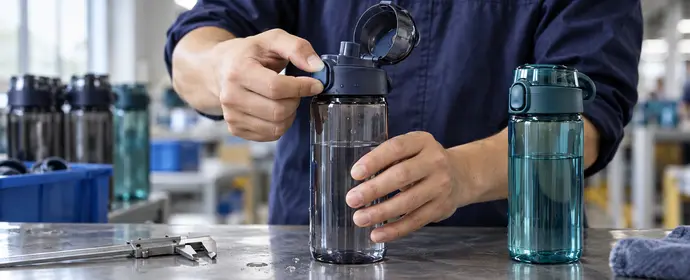
Start with the use case and the compliance route, then narrow the resin shortlist. A bottle for chilled water in an office program, a squeeze bottle for cycling, and a large-format motivational bottle each place different demands on the material and on the documentation package. The questions that matter most are:
- Food-contact status: Does the supplier hold a declaration of compliance or food-contact statement for the specific grade and finished article?
- Target-market rules: Which regulations apply in the destination country, and what form of declaration does the buyer or retailer require?
- Product design: Will the bottle be transparent, frosted, colored, printed, or fitted with a straw, flip top, or push-button lid?
- Cleaning and reuse: Is the bottle intended for single-use or repeated use, and what cleaning instructions will be printed on-pack?
- Migration testing: Has the finished product been tested for overall and specific migration under the intended use conditions?
These questions belong in the RFQ, not in a late-stage email after tooling is committed. For a broader view of bottle formats before you fix the material, the plastic water bottle types buyer’s guide for custom orders is a useful starting point.
Plain-language comparison of relevant plastics such as Tritan, PP, PETG and PE
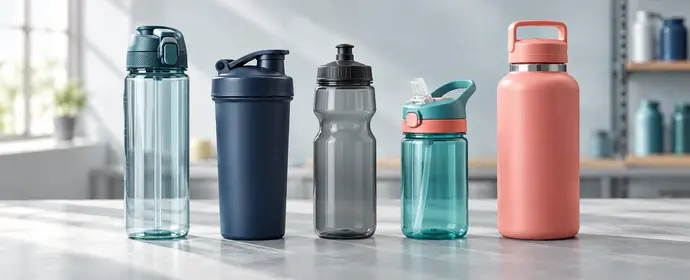
Four resin families come up most often in reusable water bottle projects. Each has general characteristics that inform design, but none of those characteristics should be read as a compliance claim for a specific grade or finished bottle.
Tritan™ copolyester
Tritan™ is Eastman’s brand of copolyester, and it is not a single formulation. Different grades are developed for different processing and end-use requirements. In general terms, Tritan is chosen when clarity, toughness and a glass-like appearance are priorities. Buyers should ask for the grade-specific documentation and avoid treating “Tritan” as a synonym for a particular regulatory status. For a deeper look at how the material is positioned in bottle design, see the guide to what a Tritan water bottle is, its material uses and custom options.
Polypropylene (PP)
PP is widely used for caps, closures, shaker bottles and opaque or semi-translucent bodies. It offers good chemical resistance in general terms and is often selected where a natural or colored finish is acceptable. PP is not typically chosen for glass-clear transparency, so it suits designs where clarity is not the main selling point.
PETG
PETG is a glycol-modified PET that is used for clear, rigid bottles and displays. It offers good clarity and can be produced in thick-walled designs, but it is less commonly specified for hot-fill or aggressive cleaning regimes. Buyers should confirm the intended cleaning and use conditions with the supplier before selecting PETG for a reusable bottle program.
Polyethylene (PE)
PE, including HDPE and LDPE, is common in squeeze bottles, jugs and closures. It is flexible, opaque in most grades, and suited to large-format or low-cost programs. PE is not a clarity material, so it fits designs where the bottle body does not need to show the liquid.
None of these descriptions replace a grade-specific declaration. A resin name alone does not prove food-contact compliance, and two grades within the same family can carry different documentation.
Transparency, weight, impact resistance, flexibility, odor, cleaning and product-design considerations
Material selection is a design trade-off. The table below summarizes how the common options typically behave, with the reminder that finished-part performance depends on wall thickness, bottle geometry, processing and test conditions.
| Consideration | Tritan™ copolyester | PP | PETG | PE |
|---|---|---|---|---|
| Transparency | Typically high clarity | Usually translucent to opaque | Typically clear | Usually opaque |
| Weight and rigidity | Rigid; wall thickness affects weight | Rigid; often lighter walls | Rigid; thick walls possible | Flexible; squeeze-friendly |
| Impact behavior | Generally chosen for toughness | Moderate; design-dependent | Moderate; can be brittle in thin sections | Good for flexible applications |
| Odor and taste | Grade-specific; request sensory data | Grade-specific; request sensory data | Grade-specific; request sensory data | Grade-specific; request sensory data |
| Cleaning and reuse | Confirm with supplier for intended regime | Common for reusable caps and bottles | Confirm cleaning limits | Common for single-use and squeeze bottles |
Odor and taste are often overlooked. A resin can meet migration requirements and still impart a noticeable taint if processing or storage is poorly controlled. Buyers should ask for sensory evaluation data or run a taste panel on samples before approving a grade for a flavored or premium water product.
Cleaning is another design driver. Bottles intended for repeated use need to withstand the cleaning method the brand recommends. If the plan is dishwasher cleaning, confirm that the finished bottle, closure and any straw or gasket have been evaluated under that regime. If hand washing is specified, the on-pack instructions should match.
Use limitations and why material behavior depends on grade, design, processing and test conditions
Material data sheets describe the resin, not the finished bottle. Once the resin is molded into a bottle with a specific wall thickness, gate location, closure fit and decoration, the finished article has its own performance and migration profile. That is why a compliance statement for a resin pellet is not the same as a compliance statement for a decorated, assembled bottle.
Processing matters as well. Drying, melt temperature, mold temperature and cooling time all influence clarity, residual stress and dimensional consistency. A bottle that looks clear in a sample can show haze or stress cracking if the process window is not controlled. For Tritan and PETG in particular, drying and thermal history affect finished-part appearance and strength. Buyers should ask how the supplier controls these variables and what in-process checks are performed.
Test conditions also define the claim. Migration testing depends on the simulant, temperature and contact time selected for the intended use. A test report for one set of conditions does not automatically cover a different filling temperature, cleaning regime or storage duration. The buyer’s job is to confirm that the test conditions match the actual product use.
Target-market questions: food-contact declarations, test reports and buyer-specified documentation
Documentation requirements vary by market and by customer. In the European Union, food-contact compliance is typically supported by a declaration of compliance and supporting migration test data. In the United States, food-contact substances are generally addressed through FDA regulations and, where applicable, food-contact notifications. Other markets have their own frameworks and may require additional declarations, certificates or language-specific labeling.
A practical documentation package for a food grade water bottle often includes:
- A declaration of compliance or food-contact statement for the finished bottle, closure and any straw or gasket.
- Migration test reports covering the intended use conditions.
- Material safety data sheets for the resin grades used.
- Documentation for colorants, additives and inks that come into contact with the bottle or are printed on it.
- Declarations required by the buyer’s own specification, such as a statement on substances of concern.
Buyers should also ask who issues each document and whether it is specific to the production site and the exact bill of materials. A generic certificate that names a resin family but not the finished product is weak evidence. For private-label programs, the brand owner is usually the party that must hold and pass on the compliance file, so the supplier’s documentation must be usable in that chain.
Where the buyer’s market requires it, additional testing may be needed for the closure, the printed decoration or the assembled bottle. Confirm the scope of any test report before relying on it.
What the buyer must confirm for the exact material, product and destination market
Before approving a food grade plastic water bottle, the buyer should be able to answer these questions in writing:
- Exact grade and supplier: Which resin grade, from which producer, is used for the body, closure and any accessories?
- Finished-product declaration: Does the declaration cover the assembled, decorated bottle as shipped?
- Intended use conditions: Do the migration tests match the filling temperature, contact time and cleaning method the brand will specify?
- Market-specific requirements: Has the supplier confirmed the documentation format and language required in the destination market?
- Change control: Will the supplier notify the buyer before changing resin grade, additive, colorant or decoration ink?
- Traceability: Can the supplier link production lots to the material and test documentation?
These confirmations should be part of the approved sample and purchase order, not a separate side file. If a supplier cannot provide a finished-product declaration, that is a material risk for the brand owner regardless of the resin’s reputation.
Where buyers should go next: compare product categories, documentation needs and inquiry options
Material selection is easier once the bottle format and application are fixed. Buyers comparing formats can review the plastic water bottles collection, or narrow by use case such as sports and fitness, outdoor adventure, or retail and private label. For programs that need branding, the customization page and custom logo water bottles page explain how decoration choices interact with material and compliance. If the project requires a specific documentation package, prepare the list of required declarations and test reports before requesting samples, and use the sample request page to evaluate both the bottle and the paperwork. When the specification is ready, submit an RFQ with the target market, intended use and documentation requirements so the supplier can respond with the applicable grade and file set.
Frequently Asked Questions
What documents should I request to verify a food grade plastic water bottle?
Ask for a declaration of compliance or food-contact statement for the finished bottle, closure and any straw or gasket, plus migration test reports covering the intended use conditions. Also request material safety data sheets for the resin grades and documentation for colorants, additives and inks. The exact package depends on the destination market and the buyer’s specification.
Does Tritan automatically mean a bottle is food-safe?
No. Tritan™ is Eastman’s copolyester brand, and compliance depends on the specific grade and finished product. A bottle made from a Tritan grade still needs a finished-product declaration and migration testing for its intended use. Buyers should verify the grade and documentation rather than relying on the brand name.
How do PP, PETG and PE compare for water bottles?
PP is common for caps, closures and opaque or translucent bottles, while PETG is used for clear rigid bottles. PE is typical for squeeze bottles and jugs where flexibility and opacity are acceptable. Each family includes multiple grades, so clarity, toughness, cleaning tolerance and food-contact documentation must be confirmed for the exact grade and design.
Why does the same resin grade perform differently in different bottles?
Finished-part performance depends on wall thickness, bottle geometry, gate location, drying, melt and mold temperatures, cooling and decoration. These variables affect clarity, residual stress, dimensional consistency and migration behavior. That is why a resin data sheet is not a substitute for testing the finished bottle under its intended use conditions.
What should I confirm before approving a private-label water bottle?
Confirm the exact resin grades and suppliers for the body, closure and accessories, and that the declaration covers the assembled and decorated bottle as shipped. Check that migration tests match your filling temperature, contact time and cleaning method, and that the documentation format meets your destination market. Also agree on change control and lot traceability before production.