
What Is a Tritan Water Bottle? Material, Uses & Custom Options
Key Takeaways
- Tritan™ is Eastman’s brand name for a family of copolyester grades, so the exact grade and finished-bottle specification still matter.
- Clarity, toughness, odor, temperature limits and cleaning guidance depend on the selected grade, bottle design, processing and decoration.
- Food-contact and BPA-related claims should be supported by documentation that applies to the material grade and destination market.
- For OEM projects, buyers should confirm the bottle model, lid system, logo method, packaging and sample-approval criteria before bulk production.
Tritan™ water bottles are clear reusable plastic bottles made with grades from Eastman’s Tritan copolyester family. For a B2B buyer, however, specifying “Tritan” is only the starting point. The selected resin grade, bottle geometry, lid components, decoration, intended use and destination-market documentation should all be confirmed before a purchase order is finalized.
What Tritan Means in a Water Bottle Sourcing Project
Tritan is a branded copolyester family rather than one universal bottle formulation. Different grades are developed for different processing and end-use requirements, so a buyer should identify the resin manufacturer and grade whenever material identity is important to the project. The finished bottle also matters: wall thickness, shape, neck design, closure components and processing conditions can affect how the product looks and performs.

For private-label or wholesale programs, the practical question is not simply “Is this Tritan?” It is “Which Tritan grade and bottle construction are being quoted, and what documentation supports the claims required for my market?”
Tritan Compared With PP, PETG and PE
Several plastic families can be considered for reusable drinkware, but they serve different design and commercial goals.
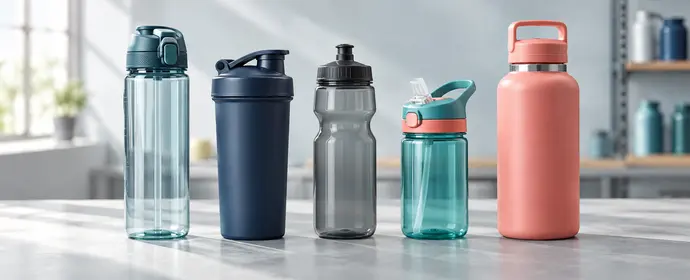
- Tritan copolyester: often selected when buyers want a clear, rigid-looking reusable bottle with a premium appearance. The exact grade and product design determine the relevant performance limits.
- Polypropylene (PP): widely used for lids, shaker cups and many reusable bottle components. It is lightweight and available in many grades, but it is usually less glass-like in appearance than clear copolyester.
- PETG: a clear copolyester used in selected molded products and packaging applications. Suitability for a reusable bottle should be confirmed for the specific grade, process and use conditions.
- Polyethylene (PE): HDPE and LDPE are common where flexibility or squeeze performance is useful, such as cycling and sports squeeze bottles.
There is no single “best” plastic for every bottle. The correct choice depends on the drinking system, target appearance, handling requirements, cleaning expectations, decoration method, order economics and destination-market requirements.
Clarity, Toughness, Odor and Cleaning Depend on the Finished Product
Clarity and appearance
Tritan is commonly chosen for transparent reusable bottles, but resin selection alone does not determine the final appearance. Mold finish, drying, processing conditions, wall thickness and part geometry can influence clarity, surface quality, residual stress and dimensional consistency.
Impact and everyday handling
A material data sheet can describe resin properties, but a finished bottle should still be evaluated as a complete product. A large thin-wall bottle, a compact sports bottle and a shaker cup can behave differently even when their bodies use the same resin family. If drop or impact performance is important, define the test condition and confirm the result on the selected bottle.
Odor and taste
Odor can be influenced by resin grade, additives, processing, storage, packaging, lid materials and cleaning. It is better to evaluate an actual sample than to assume that every bottle made from the same resin family will have identical sensory characteristics.
Cleaning and temperature limits
Dishwasher, hot-liquid and cleaning claims should be confirmed for the complete bottle, including the body, lid, seals, straw and decoration. A bottle body may tolerate conditions that a printed logo, gasket or accessory does not. Use supplier care instructions and product-specific validation instead of applying a general claim to every Tritan bottle.
Food-Contact and Compliance Documents to Confirm
Food-contact requirements vary by destination market and by the exact material and product. A buyer may need a resin declaration, declaration of compliance, migration testing or other documentation requested by a retailer, importer or local regulation. In the United States, food-contact status should be supported by the applicable regulatory basis and supplier documentation. For EU projects, buyers may need documentation relevant to EU food-contact requirements, including EU 10/2011 where applicable.
A generic statement such as “FDA approved” or “EU compliant” is not enough by itself. Ask which resin grade and finished product the document covers, when it was issued and whether the report matches the configuration being ordered.
Customization Considerations for Tritan Bottles
Once the bottle model is selected, customization should be checked against the actual surface and geometry. Logo size, print position, bottle color, lid color, measurement graphics, labels and packaging can all affect the final presentation. Curved surfaces and transparent bodies also make artwork placement more visible, so a decorated sample is useful before bulk production.
Use the Tritan Water Bottles category to compare current bottle formats. For logo, color and packaging options, review Customization before preparing artwork.
Buyer Checklist Before Approving a Tritan Bottle
- Confirm the bottle model, capacity, dimensions and lid system.
- Confirm the resin manufacturer and grade when material identity is part of the specification.
- Review the applicable food-contact and market-specific documentation.
- Define logo method, print area, bottle and lid colors, accessories and packaging.
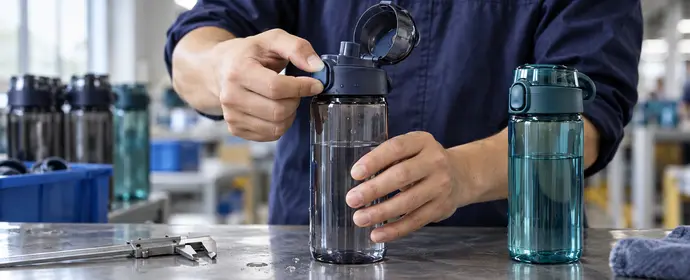
- Evaluate a sample for appearance, lid operation, sealing, odor, artwork and cleaning instructions.
- Record the approved sample and final specification before mass production.
- Request the quotation, MOQ and production schedule for the exact configuration rather than relying on a generic range.
| Area | What to evaluate | What to confirm |
|---|---|---|
| Material | Clear copolyester body and project fit | Manufacturer, resin grade and applicable documentation |
| Product design | Capacity, wall design, neck, lid and accessories | Finished-bottle specification and approved sample |
| Performance | Handling, sealing, cleaning and intended use | Product-specific test method or care guidance where required |
| Branding | Logo, color, graphics and packaging | Decorated sample and artwork approval |
| Commercial plan | Quantity, packaging and destination market | Exact quotation, MOQ and production schedule |
Next Steps for Buyers
If Tritan is a good fit for your project, shortlist one or two existing bottle structures first, then confirm material documentation and customization on the exact model. You can request a sample before bulk production or send your bottle type, quantity, destination market and branding requirements through the Contact page for a project-specific quotation.
Frequently Asked Questions
Is Tritan the same as polycarbonate?
No. Tritan is Eastman’s copolyester brand, while polycarbonate is a different polymer family. They can both be clear, but buyers should confirm the exact resin grade and documentation rather than treating the materials as interchangeable.
What should I confirm when a supplier quotes a Tritan bottle?
Confirm the bottle model, resin manufacturer and grade where relevant, lid materials, decoration, packaging and documentation required for the destination market. The approved finished sample should match the specification used for bulk production.
Can a Tritan water bottle be customized with a logo?
Yes, many Tritan bottle projects use printed logos or other decoration methods, but the best process depends on the bottle surface, artwork and durability requirement. Review a decorated sample before approving bulk production.
Are all Tritan bottles dishwasher safe?
No universal dishwasher claim should be applied to every finished bottle. Cleaning guidance depends on the bottle body, lid, seals, accessories and decoration, so confirm the care instructions for the exact product.
What information is needed for a custom Tritan bottle quotation?
Provide the bottle type or reference model, capacity, quantity, destination market, logo requirements, color direction, packaging and any required documentation. That lets the supplier quote the correct configuration instead of a generic range.