What Does BPA-Free Mean for Plastic Water Bottles? A Buyer’s Guide
Key Takeaways
- BPA-free means the plastic does not intentionally contain bisphenol A, but it does not prove food-contact safety or market compliance.
- A BPA-free claim can apply to the resin, the finished bottle, or both; buyers should confirm the scope in writing.
- Tritan™ is Eastman's copolyester brand, and not all grades are the same formulation.
- Material behavior depends on grade, design, processing, and test conditions, so finished-product testing is essential for performance claims.
- Target-market documentation such as migration test reports or Declarations of Compliance should be requested before sampling.
BPA-free means the plastic used to make the bottle does not intentionally contain bisphenol A as a raw material or additive. It does not mean the bottle is automatically compliant in every market, nor does it prove food-contact safety, impact performance, or recyclability. For brand owners and procurement teams, the practical question is not whether a supplier says ‘BPA-free’ but which resin grade, finished product, and documentation package support that statement for your destination market.
Which material questions matter for this project
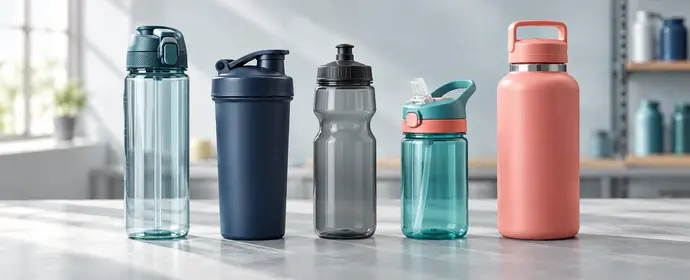
Start by separating three layers of material risk: the resin, the finished bottle, and the market. A resin data sheet may state that a grade is made without bisphenol A, but the finished bottle also involves colorants, additives, masterbatch, closures, gaskets, and decoration. Each of those can introduce substances that affect food-contact declarations or migration testing. Buyers comparing a bpa free water bottle should ask which layer a claim covers.
Key questions to resolve before sampling:
- Which resin family and grade is proposed, and does the supplier provide a current data sheet?
- Does the BPA-free statement apply to the resin, the finished bottle, or both?
- What food-contact declaration or migration test does the destination market require?
- Are closures, straws, gaskets, and decoration materials covered by the same documentation?
- Does the intended use (cold fill, ambient storage, sports, kids) change the documentation scope?
These questions matter because ‘BPA-free’ is a formulation statement, not a performance or compliance certificate. A supplier can truthfully say a resin is made without BPA while the finished product still needs its own food-contact review.
Plain-language comparison of relevant plastics such as Tritan, PP, PETG and PE
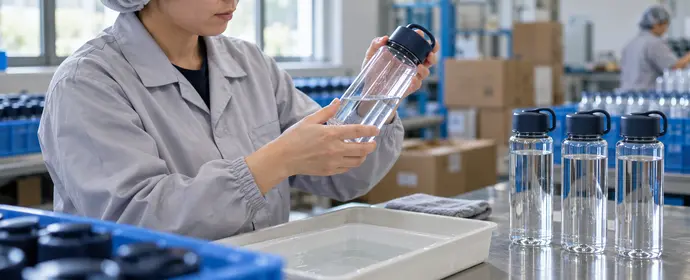
Most custom plastic water bottles use one of four resin families. Each has different processing behavior, clarity, and documentation profiles. The table below is a general orientation, not a substitute for a grade-specific data sheet.
| Resin family | Typical clarity | Processing notes | Documentation focus |
|---|---|---|---|
| Tritan™ copolyester (Eastman brand) | High clarity, glass-like | Drying, residual stress, dimensional consistency | Grade-specific food-contact declaration |
| Polypropylene (PP) | Translucent to opaque | Good chemical resistance, lower clarity | Resin and finished-product declarations |
| PETG | High clarity | Drying, scratch sensitivity, decoration adhesion | Food-contact and migration documentation |
| Polyethylene (PE) | Opaque, soft | Squeeze behavior, lower stiffness | Resin grade and additive review |
Tritan™ is Eastman’s copolyester brand, and not all Tritan grades are the same formulation. A statement about one grade does not automatically apply to another. PP is widely used for closures and bottles where clarity is less important. PETG offers clarity but may require careful handling to avoid stress cracking. PE is common in squeeze bottles and lower-cost applications. For a deeper comparison of bottle types and their material implications, see the plastic water bottle types buyer’s guide.
Transparency, weight, impact resistance, flexibility, odor, cleaning and product-design considerations
Material choice drives several design trade-offs that buyers feel in the market.
Transparency and visual appeal
Tritan and PETG generally offer higher clarity than PP or PE. If your brand relies on visible water, infuser contents, or motivational markings, clarity may be a priority. However, clarity can be affected by wall thickness, mold finish, and residual stress. A clear resin does not guarantee a clear bottle.
Weight and wall thickness
Lighter bottles reduce shipping cost but may feel less premium. Heavier walls can improve perceived quality but increase material use. The right balance depends on your retail channel and price positioning. Request a sample to evaluate feel and weight against your target.
Impact resistance and flexibility
Impact performance depends on resin grade, wall design, temperature, and drop conditions. A BPA-free claim says nothing about impact resistance. If your market requires drop testing, ask for the applicable test protocol and results for the exact product.
Odor and taste
Some resins or additives can contribute odor or taste if processing is not controlled. Drying, purging, and regrind management matter. For drinking bottles, request a sensory evaluation or migration test if your market requires it.
Cleaning and reuse
Reusability depends on design, wall thickness, and cleaning method. Narrow-mouth bottles can be harder to clean. Wide-mouth designs and removable components may help. Do not assume dishwasher or hot-water suitability without a specific product statement.
Use limitations and why material behavior depends on grade, design, processing and test conditions
A material name alone does not predict finished-part performance. Two bottles made from the same resin family can behave differently because of:
- Grade: Different grades within a family can have different flow, clarity, and additive packages.
- Design: Wall thickness, corner radii, thread design, and closure fit affect stress and leakage.
- Processing: Drying, melt temperature, mold temperature, and cooling time influence residual stress and dimensional consistency.
- Test conditions: Temperature, drop height, fill level, and duration change results.
For these reasons, a BPA-free statement should be treated as one input among many. If your product needs to meet a specific performance requirement, that requirement must be tested on the finished product under the conditions your market uses.
Target-market questions: food-contact declarations, test reports and buyer-specified documentation
Different markets ask for different documents. Common requests include:
- Resin data sheet and food-contact declaration
- Migration test reports for the finished bottle
- Declaration of Compliance (DoC) for EU markets
- FDA food-contact status for US markets
- Heavy metals, phthalates, or BPA-specific test reports
- Colorant and additive declarations
Buyers should specify the exact market and product use so the supplier can confirm which documents apply. A general ‘BPA-free’ statement is not the same as a market-specific compliance file. For retail and private label programs, documentation often needs to cover the bottle, closure, straw, gasket, and any printed decoration.
If your target market requires a specific test or declaration, request it in writing before sampling. This avoids rework and helps align the sample with the final production specification.
What the buyer must confirm for the exact material, product and destination market
Before placing a bulk order, confirm the following in writing:
- Resin identity: Exact resin family and grade, with a current data sheet.
- BPA-free scope: Whether the statement covers the resin, the finished bottle, or both.
- Component coverage: Closures, straws, gaskets, and decoration materials.
- Documentation package: Which test reports and declarations will be provided for your market.
- Sample approval: That the approved sample matches the production specification.
- Change control: How the supplier will notify you of any material or process change.
These confirmations protect your brand and reduce the risk of customs or retail rejection. They also make it easier to compare quotations on a like-for-like basis.
Where buyers should go next: compare product categories, documentation needs and inquiry options
With the material questions above resolved, the next step is to match the material to the product category and application. For example, a sports water bottle may prioritize squeeze behavior and closure security, while a kids water bottle may prioritize spill resistance and easy cleaning. A protein shaker bottle may need mixing performance and odor control. Review the relevant category pages to see which constructions are available, then align the material and documentation to your market.
Customization options such as logo printing, color matching, and private label packaging also affect the documentation scope. Decoration inks and adhesives may need their own declarations. If you are planning a private label program, review the customization and private label water bottles pages to understand what information the supplier needs from you.
When you are ready to compare materials, request a sample and a specification sheet for the exact product you are considering. Provide your destination market, intended use, and required documents so the supplier can respond with the correct information. For projects that need a formal quotation, submit an RFQ with your target quantity, customization requirements, and documentation needs.
Frequently Asked Questions
Does BPA-free mean the water bottle is food-safe?
No. BPA-free only states that bisphenol A is not intentionally used in the material. Food-contact safety depends on the finished product meeting the applicable regulations and testing for your market. You should request the specific food-contact declaration or migration test report for the exact bottle.
Is Tritan BPA-free?
Tritan™ is a copolyester brand from Eastman, and Eastman states that its Tritan copolyesters are made without bisphenol A. However, not all Tritan grades are identical, and the finished bottle may include other components. Confirm the BPA-free status for the specific grade and finished product with your supplier.
What documentation should I ask for to prove BPA-free status?
Ask for a current resin data sheet, a BPA-free declaration covering the resin and finished product, and any market-specific test reports such as migration testing. The exact documents depend on your destination market and product use. Specify these requirements before sampling.
Can a BPA-free bottle still fail compliance testing?
Yes. Compliance depends on the finished product, including colorants, additives, closures, and decoration. A bottle made from a BPA-free resin can still fail if other components or processing introduce non-compliant substances. Always test the finished product against your market requirements.
How do I compare BPA-free materials for custom water bottles?
Compare resin families such as Tritan, PP, PETG, and PE on clarity, processing behavior, and documentation. Then match the material to your product category and market. Request samples and specification sheets for the exact products you are considering, and confirm the documentation package in writing.